

Delivery modes
Delivery decides when rows leave for your database. It is a house setting rather than a metric setting, because it describes your deployment rather than what you are measuring. The same schema file runs on a laptop against memory() and in production against Redis, and only one of those has a reason to hold data back.
const house = createHouse({
  driver,
  schema,
  delivery: 'staged',     // 'staged' | 'immediate' | 'auto'
})
The two modes
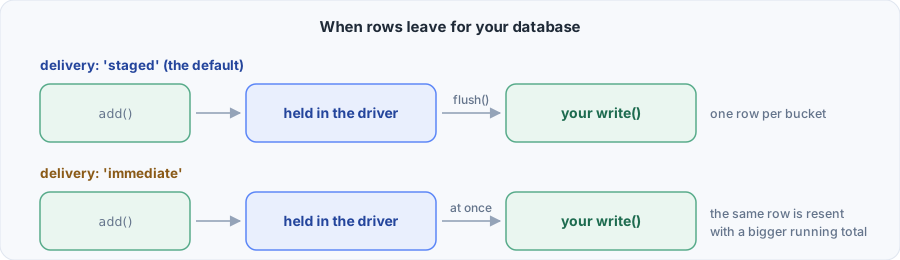
staged, the default
Writes go into the driver and stay there. A flush claims the finished windows and hands them over. Your write function sees each window exactly once, with its final value.
This is what you want almost always.
immediate
Rows go to your write function as the data arrives, without waiting for a flush. Use it when the driver cannot be trusted to hold data, which in practice means a memory driver on a platform that can freeze or discard your process at any moment.
const house = createHouse({ driver: memory(), schema, delivery: 'immediate' })auto
Asks the driver. If the driver cannot survive a restart, holding data back puts it at risk for no benefit, so auto chooses immediate. Otherwise it chooses staged.
const house = createHouse({ driver, schema, delivery: 'auto' })

house.delivery // 'staged' or 'immediate', already resolved| Driver | 'auto' resolves to |
|---|---|
memory() | 'immediate' |
ioredis() | 'staged' |
What immediate does to each metric type
The two storage styles behave differently here, and the difference is not cosmetic.
Events and logs
A record is complete the instant you write it, so immediate delivery claims it and ships it exactly as a flush would, just without waiting. Records leave the driver and are deleted normally.
For these, immediate delivery replaces flushing while the sink succeeds. Each send takes every record waiting. With a claimLimit, an event staged in the driver claims again while a claim comes back full, so one send still empties the backlog.
When a send fails, its records go back to where they were staged, and record() stops sending for a while, so a sink that is down is not handed the whole backlog again by every new record. A locally staged event holds back for batch.maxAge after the failure, and its age clock retries everything then on its own. An event staged in the driver holds back for its flush interval and has no timer of its own: its records wait until a flush claims them, or until the first record() after the interval sends them together with the new one. An event that can go quiet after a failure still wants a flush on a schedule, and house.stop() makes a final one.
Counters, gauges and timers
A window that is still filling is not complete. Immediate delivery sends the cumulative value of the open window and deletes nothing, so each send carries a running total that supersedes the one before it.
add()  ->  write [{ id: 'abc', value: 1 }]
add()  ->  write [{ id: 'abc', value: 2 }]
add()  ->  write [{ id: 'abc', value: 3 }]
Same id every time, with a larger value. That is why it has to be cumulative: the row id is derived from the metric, the window and the dimension values, and deliberately not from the value. Sending one row per increment would mint the same id three times with value: 1, and a table that keeps the last write would end up believing the answer was one.
Your table must upsert on id, and let the flush row win
Under immediate delivery, a folded row is a running total that a later send replaces. A table that adds up duplicate ids will badly over count, and one that keeps whichever row arrived last can end on an older total than the flush row. The house warns about this once at startup through onWarn.
In Postgres that means ON CONFLICT (id) DO UPDATE. In ClickHouse it means ReplacingMergeTree(final) with a final column that is 1 on a flush row. A plain ReplacingMergeTree keeps the row inserted last, so an immediate row that arrives after the flush row would replace it. Both tables are shown in Telling the two apart in your sink.
Flushing is still required for folded metrics
Immediate delivery does not retire finished windows. A counter still needs flush() from a timer, a cron or a direct call so that closed windows are claimed and deleted, otherwise they pile up in the driver forever.
The flush sends the same id with the complete value, so it supersedes every partial send, as long as your table lets it. An immediate send reads the running total and then calls your function, and a flush can claim the window in between. Within one process the flush waits for the immediate sends already under way for that metric that could have read a window it claimed, so its row reaches your function after theirs. Sends that start after the claim cannot read the claimed window, and a send aimed at a window newer than every one the flush claimed reads none of them, so neither is waited for.
The wait for a send lasts until one flush interval after that send started. A write function that never answers an immediate send would otherwise hold up every flush of the metric. When the interval runs out, the flush hands its rows over anyway, and no later flush waits for that send again. The send still waiting may then reach your function after the flush row, with an older total under the same id, exactly as a send from another process can. The table below keeps the flush row in that case.
That limit belongs to the flush alone. drain() and house.stop() wait for every immediate send already under way, with no limit, so a write function that never answers keeps them waiting for ever. Give your write function a timeout of its own, as Writing a sink shows.
Across processes nothing can order the two. Another process may read its running total just before the claim and deliver it just after the flush row. So your table has to let a row whose source is 'flush' win over an 'immediate' row with the same id, whichever arrives last. Telling the two apart in your sink shows one way.
A write that arrived after its window was claimed is moved forward to a window that has not shipped, and the immediate send follows it. Once this process has claimed the window the write aimed at, or when that window reads back empty, the send asks the driver which window the write landed in, and sends every live window of that series from the one the write aimed at through that one. A window a failed flush of this process released can sit in front of the landing window, or be the aimed window itself, and the landing window is still sent. Otherwise the send reads the aimed window alone, which saves a driver call on nearly every write. The one case it misses is a window another process claimed and then put back, after a failed flush or a recovery: a write aimed there is moved forward and the send carries only the window it aimed at. The flush ships the landing window with its full value either way. A failed send counts toward attempt exactly as a failed flush does.
With several processes writing to one Redis, each of them sends the running total it read, and two immediate sends can arrive at your table in either order. A table that keeps whichever row arrived last can briefly hold an older total. Rows carry no version number to settle that. What settles it is the flush row, which holds the complete value, provided your table keeps it over any immediate row that arrives after it.
| Events and logs | Counters, gauges, timers | |
|---|---|---|
| Immediate delivery replaces flush | Yes | No |
| Still need to call flush | Only to retry a failed send of a driver staged event | Yes, to retire finished windows |
| Rows are deleted after sending | Yes | Only by a flush |
| Duplicate ids in your table | No | Yes, upsert on id and keep the flush row |
Telling the two apart in your sink
context.source says which path a call came from. Under immediate delivery a folded metric's flush row carries the id its immediate rows already used, so every source is an upsert on id. The table also records whether the row it holds came from a flush, and an immediate row never replaces one that did.
CREATE TABLE http_requests (
  id         TEXT PRIMARY KEY,
  bucket_ts  TIMESTAMPTZ NOT NULL,
  route      TEXT NOT NULL,
  value      BIGINT NOT NULL,
  final      BOOLEAN NOT NULL
);CREATE TABLE http_requests (
id String,
bucket_ts DateTime64(3),
route String,
value Int64,
final UInt8
)
ENGINE = ReplacingMergeTree(final)
ORDER BY (bucket_ts, route);write: async (rows, context) => {
// true for a flush row, which holds the window's complete value
const final = context.source === 'flush'
await sql`
INSERT INTO http_requests ${sql(
rows.map((row) => ({ ...row, final })),
'id', 'bucket_ts', 'route', 'value', 'final',
)}
ON CONFLICT (id) DO UPDATE SET value = EXCLUDED.value, final = EXCLUDED.final
WHERE EXCLUDED.final OR NOT http_requests.final
`
}write: async (rows, context) => {
// 1 for a flush row, which holds the window's complete value
const final = context.source === 'flush' ? 1 : 0
await clickhouse.insert({
table: 'http_requests',
values: rows.map((row) => ({ ...row, final })),
})
}ReplacingMergeTree(final) keeps, among the rows that share a sorting key, the one with the largest final, and the one inserted last when they tie. A flush row therefore beats every immediate row, and a flush row resent after a failed acknowledgement replaces the earlier copy with the same value. ClickHouse removes the losing rows when it merges parts, so a query that must not see them before then reads FROM http_requests FINAL.
The WHERE on the update is what lets the flush row win. A later immediate row for the same id finds final set and changes nothing, and a flush resent after a failed acknowledgement replaces the row with the same value.
source | When | What your table should do |
|---|---|---|
'flush' | A normal flush | Upsert on id. Under immediate delivery it replaces the running totals sent before it, and keeps its place against any that arrive after it |
'batch' | A locally staged event shipped itself | Insert, or upsert on id. A duplicate is an identical retry |
'immediate' | Immediate delivery | Upsert on id, unless the row held came from a flush |
Choosing
| Situation | Delivery |
|---|---|
| A server that stays running, any driver | 'staged' |
| Serverless or edge with a shared driver | 'staged', flushed from a cron |
Serverless or edge with memory() | 'immediate', and events only: each isolate's counter total overwrites the others' |
| Not sure, and you want the safe default | 'auto' |
| You want rows in your database within a second | 'immediate' |
Immediate delivery costs one extra read and one write call per write you make. It reads only the series that changed, so the cost scales with how often you write rather than with how many distinct label combinations the metric has. It is still a call to your database per application write, so treat it as a deliberate trade rather than a default.
Defaults for a whole house
Alongside delivery, a house can supply the cadence and grace that metrics use when they declare none.
const house = createHouse({
  driver,
  schema,
  defaults: { flush: '1m', grace: '5s' },
})// Takes flush: '1m' and grace: '5s' from the house.
const requests = counter('requests', {
resolution: '10s',
write: toClickHouse('requests'),
})
// Keeps its own, whatever the house says.
const payments = counter('payments', {
resolution: '1s',
flush: '5m',
write: toClickHouse('payments'),
})Defaults are filled in, never overridden. Delivery mode is the one thing a house decides outright, because "this platform cannot flush" is a fact about the deployment that a schema file has no standing to argue with.
A metric with no cadence anywhere is an error
A counter, gauge, level or timer that declares no flush and is registered with a house that supplies no defaults.flush throws at startup. Events and logs fall back to '30s', since they have no resolution for a cadence to divide.
In production
The pattern that covers most deployments:
// metrics/house.ts
import { createHouse } from 'metrichouse/core'
import { memory } from 'metrichouse/memory'
import { ioredis } from 'metrichouse/ioredis'
import { Redis } from 'ioredis'
import * as schema from './schema.js'

const useRedis = Boolean(process.env.REDIS_URL)

export const house = createHouse({
  driver: useRedis ? ioredis(() => new Redis(process.env.REDIS_URL!)) : memory(),

  // Redis can hold data safely, so wait for a flush. Memory cannot, so ship now.
  delivery: 'auto',

  schema,
  defaults: { flush: '1m', grace: '5s' },
  onWarn: (message) => logger.warn({ message }, 'metrichouse'),
  onError: (error, { metric }) => logger.error({ err: error, metric }),
})

logger.info({ delivery: house.delivery }, 'metrics ready')
Log house.delivery at startup. It is a single line that tells you, during an incident, whether your rows should be arriving continuously or in batches.