

How it works
This page follows one number from the moment your code records it to the moment it lands in your database.
The five stages
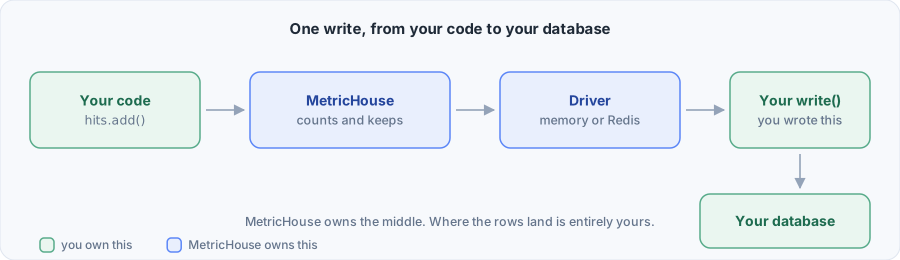
- Your code writes.
counter.add(),gauge.set(),event.record(),log.info()ortimer.end(). These return straight away. - MetricHouse works out where it belongs. It applies defaults, checks the value against what you declared, works out the time window and builds the series key from your dimension values.
- The driver holds it. Either in plain maps inside your process, or in Redis if several servers need to share one set of totals.
- A flush takes what is finished. The data is set aside, turned into rows, and handed to your
writefunction. - Your function stores it. If it succeeds the data is deleted. If it throws, the data goes back and comes again next time.
Two storage styles
The six metric types split into two groups, and the difference explains most of the behaviour you will meet.
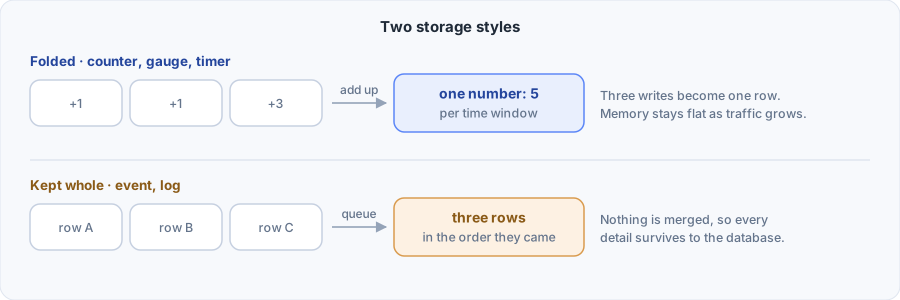
Folded. A counter, a gauge, a level and a timer combine writes into one value per window. A thousand increments in one second become one row that says 1000. Memory use depends on how many different label combinations you have, not on how much traffic you get.
Kept whole. An event and a log keep every record. Two identical events are two rows, because the reason to use an event at all is the detail, and detail does not survive being added together.
You can see which style a metric uses at runtime:
pageViews.storage   // 'bucketed'
signups.storage     // 'staged'
Time windows
Every folded metric groups writes into fixed windows called buckets. A bucket is resolution wide and lines up with the Unix epoch, not with when your process started. That means two servers never disagree about where a minute begins, with no coordination between them.
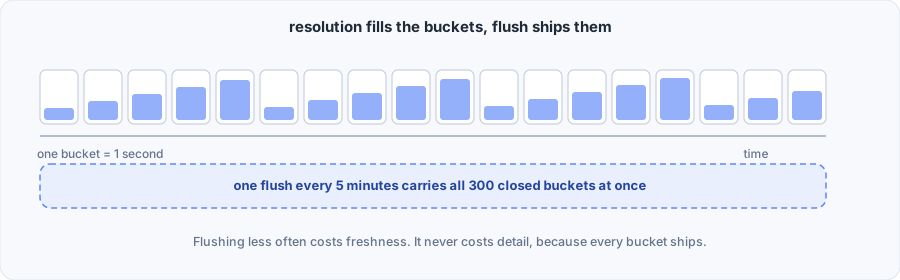
A metric with resolution: '1s' and flush: '5m' keeps one second of detail and ships 300 rows every five minutes. Shipping less often costs freshness. It never costs detail.
There is a full explanation in Buckets and time.
Dimensions become rows
Dimensions are the labels you want to break a number down by. Every combination of values you actually write becomes its own running total, and each one becomes its own row.
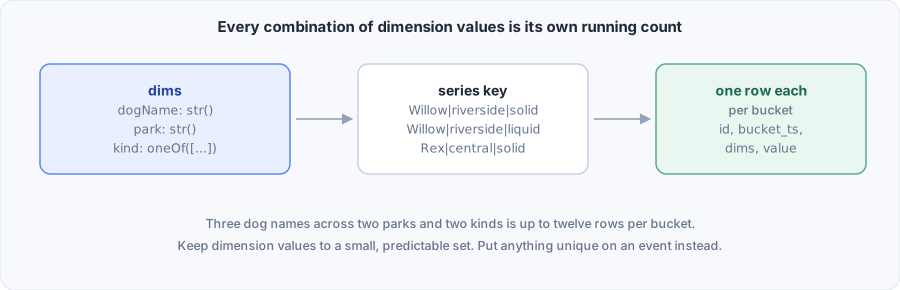
This is the setting that decides how much data you generate, so it is worth understanding before you ship. dims covers the declaration, the argument at each call site and what cardinality costs.
The flush handshake
A flush never deletes anything before your write succeeds.
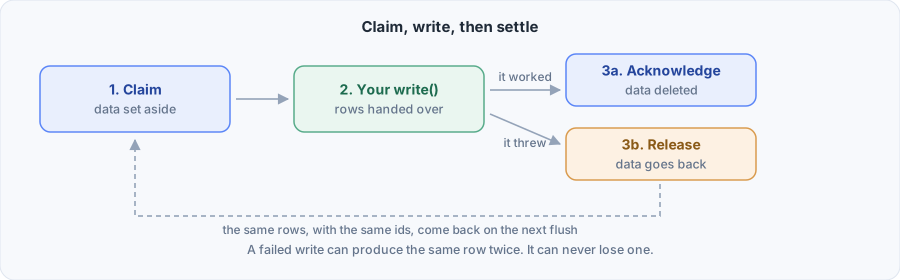
- Claim. Everything eligible is moved out of the live set into a holding area. It is now invisible to live reads and to any other flush, so two servers can never ship the same window.
- Write. Your function runs with the rows.
- Acknowledge or release. If your function returns, the claimed data is deleted. If it throws, the data goes back exactly as it was, with the same row ids, and the next flush tries again with
attemptincreased by one.
The consequence is worth stating plainly. A failed write can produce the same row twice. It cannot lose a row. See Reliability for what that means for your table.
Nothing runs on its own
createHouse() starts no timers and opens no connections. That is what makes it safe to call at the top level of a module on a platform that reruns module code on every cold start.
Something has to ask for a flush. There are three choices, and they are all ordinary function calls:
house.start()              // one timer per metric, for a server that stays up
await house.flush()        // a cron job, a request handler, a worker loop
await pageViews.flush()    // just this one metric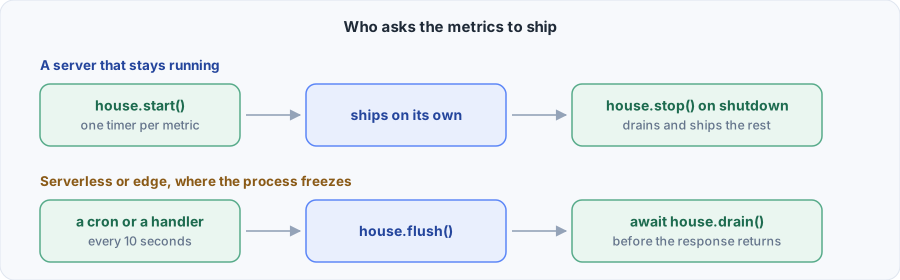
What this means in practice
- Measuring something costs a validation pass and a map update. With the
memory()driver that is all it costs. Withioredis()the write is queued and sent to Redis in the background, soadd()still returns immediately without waiting for it. - Nothing you write is visible to your database until a flush runs.
- You can always read the current numbers without touching your database.
- If your database is down, writes keep being accepted and pile up in the driver. They ship when it recovers.