

Reliability
This page says exactly what MetricHouse promises, what it does not, and what you have to do to hold up your end.
The promise
A row is never lost because a write failed. A row may arrive twice.
That is the trade, and it is deliberate. The alternative would be deleting data before knowing the write succeeded, which turns every database hiccup into permanent loss.
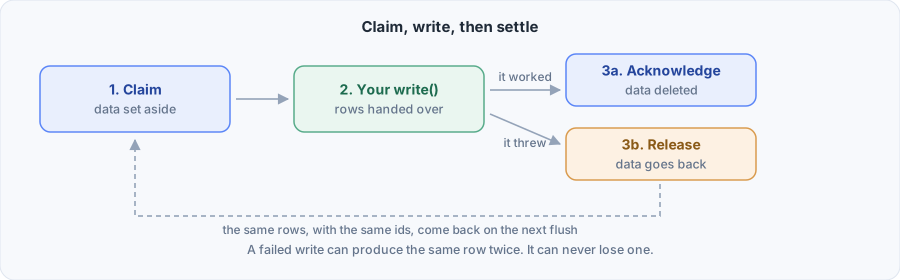
When your write function throws:
- Nothing is deleted.
- The claimed data goes back into the live set, unchanged.
- The next flush sends the same rows, with the same ids, and
attemptgoes up. Writing a sink says exactly how it is counted.
Making a duplicate harmless
Every row carries an id. For counters, gauges and timers that id is derived from the metric name, the time window and the dimension values, so the same window shipped twice produces exactly the same id, with no stored state anywhere.
Your table decides what to do about that.
-- Fine for the default delivery. For immediate delivery use
-- ReplacingMergeTree(final), see Delivery modes.
CREATE TABLE http_requests (
  id         String,
  bucket_ts  DateTime64(3),
  route      String,
  value      Int64
)
ENGINE = ReplacingMergeTree
ORDER BY (bucket_ts, route);CREATE TABLE http_requests (
id TEXT PRIMARY KEY,
bucket_ts TIMESTAMPTZ NOT NULL,
route TEXT NOT NULL,
value BIGINT NOT NULL
);await sql`
INSERT INTO http_requests ${sql(rows, 'id', 'bucket_ts', 'route', 'value')}
ON CONFLICT (id) DO UPDATE SET value = EXCLUDED.value
`Use DO UPDATE rather than DO NOTHING. A retry resends a row with the value it had the first time, so either handles that. Under immediate delivery a row is also sent again as its window fills, with a larger value each time, and DO UPDATE takes the newer one. The flush row holds the complete value, so a sink should not let a later immediate row replace it, as Delivery modes shows.
import { naturalKey } from 'metrichouse/core'

naturalKey(httpRequests.dims)   // ['bucket_ts', 'route', 'status']
That is the column list your table should treat as unique if you would rather key on the natural columns than on id.
For events and logs, the id is a UUID version 7 minted when you call record(). Two identical events are two different rows on purpose. Because the id is minted at record time rather than flush time, a retried batch resends the same rows rather than creating new ones.
What is not protected
A process that dies mid flush, on memory()
Between claiming a window and acknowledging it, the data sits in a holding area. With memory() that holding area is a map inside your process, so a crash takes it too. There is nothing left behind to find.
With ioredis() the holding area is a real Redis key, which outlives the process that wrote it, and a later flush puts it back. See Recovering a crashed flush.
Data still on its way to the driver
add(), set() and record() return before storage has confirmed anything. A process that exits at that instant loses what was still in flight.
await house.drain() // resolves once every write issued before it has reached the driverCall drain() before exiting, and on every request on a platform that freezes your process when the response returns. It waits for the writes issued before the call, and not for those issued while it waits, so a busy server can await it. Under immediate delivery it also waits for the send to your write function that follows each of those writes.
A write the driver refuses after record() has returned goes to onError, and that record is lost. For records that must not be lost that way, declare the event durability: 'durable'. Its record() returns a promise that resolves only once the driver has the record, and rejects otherwise, so the caller can fail the request instead of reporting success.
The window that is still filling
house.stop() makes a final flush that takes every window that has ended, including those still inside grace, since the process has already drained its own writes. It waits for every flush still running first, so rows that a failed sink put back during shutdown ship with the rest. The one it cannot ship is the open window, because it has not ended. At most one resolution of data is exposed to a shutdown.
On a shared, durable driver such as ioredis() the final flush takes the metric's turn like any other flush. When another process holds the turn, the final flush ships nothing for that metric and reports skipped: true. Nothing is lost: the rows stay in Redis and ship with whichever process takes the next turn. If no process takes one, because every one has stopped, they wait until one runs again.
Keep the resolution of anything important small, or turn on immediate delivery so those values reach your database as they happen.
Writes that arrive very late
Grace holds a just finished window back from the flush for a little longer. A write that arrives after its window has been claimed anyway is moved forward into the first window of its own resolution at or past the watermark, and ships with that one. Nothing is lost and no window ships twice with different values, so a table that keeps one row per id stays correct. The write is counted a window late, which is the price of that. Buckets and time has the details.
Recovering a crashed flush
A claim moves data out of the live set. That is what stops two instances shipping the same window, and it is also why a process that dies holding one leaves data that no later flush can see: a flush claims from the live set, and the claimed window is no longer in it.
With ioredis() that window is still in Redis under a key of its own. Every flush that is going to claim first looks for claims that have been held too long, merges them back into the live set, and then claims as usual. Usually that same flush ships what it just repaired. Two cases leave part of it for later flushes:
- A recovering process whose clock is behind claims up to a watermark worked out from its own clock, and a repaired window at or past that watermark waits for a flush whose clock has passed it.
- An event or a log with a
claimLimitships at most a hundred claims of that size per flush, and a repaired backlog larger than that ships over several flushes.
You do not turn this on. It is what ioredis() does.
const report = await house.flush()

// absent on an ordinary flush, so its presence is the news
if (report.metrics.http_requests?.recovered) {
  logger.warn('a flusher died holding a batch, and it has been put back')
}interface RecoveryReport {
claims: number // abandoned claims put back
buckets: number // windows put back, across those claims
records: number // records put back, across those claims
oldestClaimedAt?: number // when the longest stranded one was taken
}Something crashing between a claim and its acknowledgement is worth knowing about, so report it rather than letting it heal quietly:
setInterval(async () => {
  const report = await house.flush()

  for (const [metric, result] of Object.entries(report.metrics)) {
    if (result.recovered) {
      const { claims, buckets, records, oldestClaimedAt } = result.recovered
      logger.warn(
        { metric, claims, buckets, records, strandedForMs: Date.now() - oldestClaimedAt! },
        'recovered a batch a dead flusher was holding',
      )
    }

    // the sweep failed. The flush below it still ran, so rows still shipped.
    if (result.recoveryError) {
      logger.error({ err: result.recoveryError, metric }, 'recovery pass failed')
    }
  }
}, 10_000)
How long it waits
A claim held by a flusher that is still writing looks exactly like a claim held by one that has died. The only thing separating them is how long it has been held, so that is what the driver goes on.
ioredis(client, { recoverAfter: '5m' }) // the defaultSet this above your sink's timeout. Set it lower and a slow write can have its window taken back and shipped by another instance, which sends those rows twice and then fails the original flush's acknowledgement. Neither of those loses data, because both sends carry the same row ids, but it is noise you do not need. The failed acknowledgement comes back on that flush's report as ackError, next to the rows it did ship, and the rest of the house still flushes. Set it higher and a window from a crashed flusher waits longer to ship.
Waiting is much the cheaper mistake, which is why the default is generous.
Why it puts the window back rather than shipping it
A recovered window goes back into the live set. It is never sent straight to your database, so it ships through the same flush, sink and acknowledgement as everything else.
It comes back exactly as the crashed flusher claimed it. A write aimed at a window some flush has claimed is moved forward to a window that has not shipped (Buckets and time), so nothing can land in the stranded window while it waits. The next flush sends the same row, with the same id and the same value, that the crashed one may already have sent, and a table that treats id as unique keeps one copy.
Records are put back at the head of the queue, behind any older records a failed flush already put back, so they ship in the order they arrived.
What it does not cover
memory()has nothing to recover. Its claims live in the process that took them, so a crash leaves nothing behind.recover()on it always reports zero, and that is honest rather than unimplemented.- A metric removed from your schema stops being swept, because nothing flushes it any more. Flush it once more before you delete it.
- A locally staged event or log,
stage: 'local', waits in your process rather than in the driver, so the same limit applies as formemory(). - A recovery that fails is reported as
recoveryErrorand does not stop the flush. The live data still ships, so one stuck claim never becomes a metric that stops delivering.
Where errors go
Some failures cannot be thrown at a caller, because the caller has already moved on. add() returned before storage answered. record() already decided to keep the event. Those failures go to onError.
const house = createHouse({
  driver,
  schema,
  onError: (error, { metric }) => {
    logger.error({ err: error, metric }, 'metric failure')
  },
})
onError receives:
- A driver write that failed after
add(),set()orrecord()returned. A durable event'srecord()has not returned by then, so its failure rejects the promise instead and does not come here. - A flush that failed on a scheduler tick, where nobody is holding the promise. Its
releaseError,recoveryErrorandackErrorcome here too. - A send under immediate delivery whose
writefunction threw, for any metric type. - A locally staged event or log whose
writefunction threw when it shipped itself onbatch.maxSize,batch.maxAgeordrain(). - A failed acknowledgement, or a failed release, after a send of a locally staged event, or after an immediate send of a driver staged one. For an acknowledgement the rows reached your sink and only the claim could not be settled. For a release the sink failed and the rows could not be put back.
- A
record()orrecordMany()refused by a locally staged event pastbatch.maxStaged, once per turn of the event loop, as the event page describes. - A broken
deriveon an event, or a brokenrecordpairing on a timer. - An
onWarnthat threw while the house registered a metric. The metric is registered anyway. - A stored series key the current dims cannot read, once per key, as Keys the declaration cannot read describes. The series ships as stored.
- A staged record the current fields cannot read, once per record, as Records staged under an earlier declaration describes. The record ships as stored.
- A locally staged event that could not ask the driver for records an earlier
stage: 'driver'declaration left there, frompending(), from a scheduled flush, or from the claim of any flush. Only the recovery pass of aflush()you call returns its failure asrecoveryErrorinstead, as the event page sets out. - A locally staged event that could not give back to the driver a claim the driver handed over after the event had stopped waiting for it.
Without a handler these become unhandled promise rejections, except the last four. That is noisy, and deliberately better than a failure disappearing quietly. A handler that throws is raised the same way, and neither case stops drain() or stop() from waiting for the rest.
The last four are dropped without a handler, because each is something the library found on its own schedule, or while a caller read data, and already copes with. The row ships as stored. Or the local buffer ships and the driver is asked again an interval later. Or the claim that was not given back stays in flight in the driver until a recovery pass returns it. Nothing was lost, and an unhandled rejection would end a Node process that set no onError. A flush() you call still returns a failure of its recovery pass in its report, as recoveryError, so a caller without a handler can see that one there. A failure while that flush claims from the driver, or while it gives back a late claim, is not in the report.
onWarn receives startup warnings about your setup, and there are three kinds:
onWarn: (message) => logger.warn({ message }, 'metrichouse')- The driver cannot survive a restart, so the guarantee is best effort.
- Delivery is immediate, so your table has to upsert on id and let the flush row win.
- An event declared
durability: 'durable'is bound to a driver that cannot survive a restart. This one comes once per such event, when the house registers it, with the event's name inmetric.
Failures you do get to handle
Errors that happen while your code is on the stack are thrown normally.
// Throws: 'unknown' is not a declared value
httpRequests.add({ route: '/x', method: 'GET', status: 'unknown' })

// Throws: this metric was never registered with a house
unboundCounter.add()

// Throws: '7s' does not divide '1m' evenly
counter('bad', { resolution: '7s', flush: '1m', write })
These are programming errors, and the earliest possible failure is the most useful one.
The one deliberate exception is a log message. Any level accepts a value that is not a string and turns it into one rather than throwing, because that call is made from inside a catch block and a logger that takes down a request handler is worse than a row that reads "42".
What to watch
Backlog
If your database is unreachable, data accumulates in the driver. Nothing is lost, but memory is not free.
// Events and logs report their backlog directly.
await signups.pending()       // 128 records staged, not yet shipped

// Redis reports how many series a metric is holding.
await driver.scanSeries('http_requests')
The memory() driver refuses writes past maxSeries or maxStaged and names the metric in the error, which turns a slow memory leak into a loud failure.
Repeated failures
let consecutiveFailures = 0

setInterval(async () => {
  const report = await house.flush()

  if (report.ok) {
    consecutiveFailures = 0
    return
  }

  consecutiveFailures += 1
  const failed = Object.entries(report.metrics)
    .filter(([, r]) => r.error)
    .map(([name]) => name)

  logger.error({ failed, consecutiveFailures }, 'flush failed, data retained')

  if (consecutiveFailures >= 10) {
    await pageOnCall('metric flush failing for 10 consecutive attempts')
  }
}, 10_000)
The attempt counter
write: async (rows, context) => {
  if (context.attempt > 1) {
    logger.warn({ metric: context.metric, attempt: context.attempt }, 'retrying')
  }
  await db.insert(rows)
}
A rising attempt means the same rows have failed several times. After enough tries, write them somewhere else and return normally so they stop being retried:
write: async (rows, context) => {
  if (context.attempt > 5) {
    await s3.put(`dead-letter/${context.metric}/${Date.now()}.json`, JSON.stringify(rows))
    return
  }
  await db.insert(rows)
}
A checklist before going live
- [ ] Your table treats
idas unique, or you upsert on the natural key. - [ ] Your
writefunction rethrows on failure rather than swallowing. - [ ]
onErroris wired to your logger. - [ ]
onWarnis wired, and you have read what it says at startup. - [ ]
house.stop()runs onSIGTERM. - [ ]
house.drain()runs before a serverless response returns. - [ ] Your dimensions have a small, known set of values.
- [ ] Events a caller must not lose are
durability: 'durable', and Redis runs withappendonly yes,appendfsync always, and amaxmemory-policythat isnoeviction. - [ ] Something alerts on repeated flush failures.
- [ ] Your sink has a timeout, and
recoverAfteris longer than it. - [ ] Your sink chunks very large batches.