

Deployment targets
The only thing that really changes between platforms is who asks for a flush, and whether the driver can be trusted to hold data between requests.
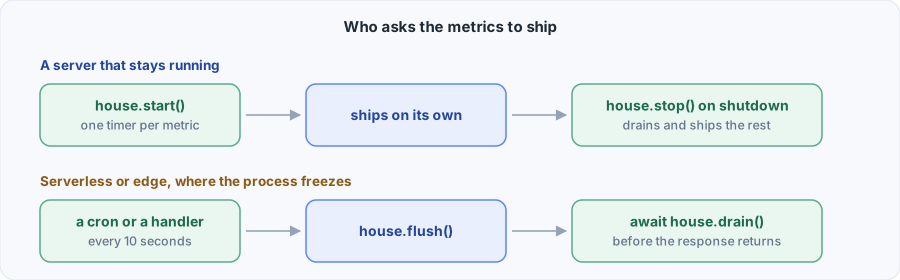
The decision in one table
| Platform | Driver | Delivery | Who flushes |
|---|---|---|---|
| Node server, one instance | memory() | 'staged' | house.start() |
| Node server, several instances | ioredis() | 'staged' | house.start() |
| Vercel functions | ioredis() | 'staged' | A cron route |
| Cloudflare Workers | ioredis() | 'staged' | A scheduled handler |
| AWS Lambda | ioredis() | 'staged' | An EventBridge rule |
| Any serverless, no Redis | memory() | 'immediate' | Nothing, plus drain() |
A Node server
The straightforward case. The process stays alive, so a timer works.
// metrics/house.ts
import { createHouse } from 'metrichouse/core'
import { memory } from 'metrichouse/memory'
import * as schema from './schema.js'
import { logger } from '../logger.js'

export const house = createHouse({
  driver: memory(),
  schema,
  defaults: { flush: '1m' },
  onError: (error, { metric }) => logger.error({ err: error, metric }),
  onWarn: (message) => logger.warn({ message }, 'metrichouse'),
})// server.ts
import { house } from './metrics/house.js'
const server = app.listen(3000)
house.start()
async function shutdown() {
server.close()
await house.stop() // clears timers, drains, forces a final flush
process.exit(0)
}
process.on('SIGTERM', shutdown)
process.on('SIGINT', shutdown)Move to ioredis() when you run more than one instance and want live reads to describe the whole fleet rather than one process.
Vercel
Functions freeze the moment a response is returned, so a timer never fires. Use a shared driver and flush from a cron route.
// metrics/house.ts
import { createHouse } from 'metrichouse/core'
import { ioredis } from 'metrichouse/ioredis'
import Redis from 'ioredis'
import * as schema from './schema.js'

// Safe at module scope: createHouse opens no connections, and the client
// factory is not called until the first write.
export const house = createHouse({
  driver: ioredis(() => new Redis(process.env.REDIS_URL!)),
  schema,
  defaults: { flush: '1m' },
})// app/api/track/route.ts
import { pageViews } from '@/metrics/schema'
import { house } from '@/metrics/house'
export async function POST(request: Request) {
const { path } = await request.json()
pageViews.add({ path })
// The isolate may freeze as soon as we return, so make sure the write landed.
await house.drain()
return Response.json({ ok: true })
}// app/api/cron/flush/route.ts
import { house } from '@/metrics/house'
export const dynamic = 'force-dynamic'
export async function GET() {
const report = await house.flush()
return Response.json({ ok: report.ok, metrics: report.metrics })
}// vercel.json
{
"crons": [{ "path": "/api/cron/flush", "schedule": "* * * * *" }]
}A minute is the finest schedule Vercel crons support. Each metric still honours its own cadence, so a five minute metric ships every five minutes and the calls in between cost one clock comparison.
Cloudflare Workers
import { house } from './metrics/house'
import { requests } from './metrics/schema'

export default {
  async fetch(request: Request, env: Env, ctx: ExecutionContext) {
    requests.add({ route: new URL(request.url).pathname })

    const response = await handle(request)

    // Keeps the isolate alive until the write reaches Redis.
    ctx.waitUntil(house.drain())

    return response
  },

  async scheduled(_event: ScheduledEvent, _env: Env, ctx: ExecutionContext) {
    ctx.waitUntil(house.flush())
  },
}# wrangler.toml
[triggers]
crons = ["* * * * *"]Timers on Workers
performance.now() on Workers only advances across input and output, so a timer measures work that waits on the network or on storage and reads pure computation as zero. Counters, gauges, events and logs are unaffected.
AWS Lambda
// handler.ts
import { house } from './metrics/house.js'
import { requests } from './metrics/schema.js'

export const handler = async (event: APIGatewayProxyEvent) => {
  requests.add({ route: event.path })

  const response = await handle(event)

  // The runtime freezes after this returns.
  await house.drain()

  return response
}

// A second function on an EventBridge rule, every minute.
export const flushHandler = async () => {
  const report = await house.flush()
  if (!report.ok) throw new Error('flush failed, see metric reports')
}
Serverless with no Redis
If you do not want a shared driver, use memory() with immediate delivery. Rows reach your database as they are written, so nothing depends on an isolate surviving.
export const house = createHouse({
  driver: memory(),
  schema,
  delivery: 'immediate',
})
The cost is one database call per application write, and folded metrics resend the same row id with a rising running total, so your table must keep the newest row per id. Read Delivery modes before choosing this.
Testing
Use memory() and an injected clock. Real time is not needed and makes tests slow and flaky.
import { beforeEach, expect, it } from 'vitest'
import { counter, createHouse, str } from 'metrichouse/core'
import { memory } from 'metrichouse/memory'

it('ships one row per path per minute', async () => {
  const written: Record<string, unknown>[][] = []

  let clock = Date.UTC(2026, 0, 1, 12, 0, 0)

  const pageViews = counter('page_views', {
    dims: { path: str() },
    resolution: '1m',
    flush: '1m',
    write: (rows) => {
      written.push(rows)
    },
  })

  const house = createHouse({
    driver: memory(),
    schema: [pageViews],
    now: () => clock,
  })

  pageViews.add({ path: '/a' })
  pageViews.add({ path: '/a' })
  pageViews.add({ path: '/b' })
  await house.drain()

  expect(await pageViews.current({ path: '/a' })).toBe(2)

  // Move past the minute boundary and past the grace period.
  clock += 90_000

  const report = await house.flush()

  expect(report.ok).toBe(true)
  expect(written[0]).toHaveLength(2)
  expect(written[0]?.[0]).toMatchObject({ path: '/a', value: 2 })
})
Three things make this reliable:
now: () => clockreplaces the real clock, so you move time instead of waiting for it.await house.drain()makes sure writes reached the driver before you read.- Moving past
resolution + graceis what makes a window eligible to ship. A flush before that correctly reports nothing.
Use flush({ force: true }) when you would rather ignore the cadence than move the clock.
Bundle size
Import the specific entry points in anything that ships to a browser or an edge runtime.
| Import | Contains |
|---|---|
metrichouse/core | Declaring, writing, reading, flushing |
metrichouse/memory | The memory driver |
metrichouse/ioredis | The Redis driver |
metrichouse | Everything, for Node servers where size is not a concern |
The package is marked side effect free, so a bundler removes what you do not use.
Checklist
- [ ] The driver matches how many processes you run.
- [ ]
house.deliveryis logged at startup. - [ ] Something asks for a flush:
start(), a cron, or immediate delivery. - [ ]
drain()runs before a serverless response returns. - [ ]
stop()runs onSIGTERM. - [ ]
onErrorandonWarnreach your logger. - [ ] Tables exist and treat
idas unique.