

level
A level records a quantity that stays where you put it. Every window from a write onwards carries that value, including the windows nobody wrote to, so a chart of it draws a line rather than a row of dots.
import { level, oneOf } from 'metrichouse/core'

export const queueDepth = level('queue_depth', {
  dims: { queue: oneOf(['email', 'export', 'webhooks']) },
  resolution: '1m',
  flush: '1m',
  write: async (rows) => clickhouse.insert({ table: 'queue_depth', values: rows }),
})queueDepth.set(42, { queue: 'email' })| Import | import { level } from 'metrichouse/core' |
| Answers | What is this value now, and what was it in between |
| Storage | One held value per series, carried into every closed window |
| Row | { id, bucket_ts, ...dims, value } |
| Write with | set(), inc(), dec() |
| Read with | current(), totals(), snapshot() |
| Use it for | Queue depth, requests in flight, connections checked out, workers running |
Every series produces a row in every window, forever, whether or not anything moved. What it costs puts a number on that.
level()
level<D>(name: string, config: LevelConfig<D>): Level<D>Declares a level. It is inert until a house binds it, and writing to an unbound level throws.
| Parameter | Type | Required | Meaning |
|---|---|---|---|
name | string | yes | The metric name |
config.dims | shape | no | Labels to break the value down by |
config.resolution | duration | yes | How wide one window is |
config.flush | duration | no | The fastest this may ship |
config.grace | duration | no | How long a late write may still land |
config.holdFor | duration | no | How long a quiet series keeps reporting |
config.value | field type | no | Whether fractions are allowed |
config.write | function | yes | Where the rows go |
name
level('queue_depth', { ... })A non empty string, unique inside a house.
dims
dims?: Record<string, FieldType> // default: noneThe labels this quantity is broken down by. Each combination holds its own value and produces its own row in every window.
dims: { queue: oneOf(['email', 'export', 'webhooks']) }Dims cost more here than on any other type, because every series reports forever. A dim whose values come and go wants holdFor. dims covers the argument itself.
resolution
resolution: DurationInput // requiredHow wide one window is, and therefore how many rows a single series writes per day. One series at '1m' is 1,440 rows a day. At '1s' it is 86,400.
Buckets and time covers the choice, and Durations the format.
flush
flush?: DurationInput // default: the house defaultThe fastest this level may ship. resolution has to divide it evenly.
Flushing does more for a level than for the other types: the carry happens here, so a level that never flushes never fills in the windows between writes. See How carry works.
grace
grace?: DurationInput // default: '2s'How long past a boundary a late write still lands in the window that just closed. Identical to the counter's.
holdFor
holdFor?: DurationInput // default: foreverHow long a series keeps reporting after its last write. Without it a series holds its value for as long as the process runs, which is the point of a level and the wrong answer for a series that can go away.
export const workerQueue = level('worker_queue', {
  dims: { worker: str() },
  resolution: '1m',
  flush: '1m',

  // A worker that dies stops reporting after five idle minutes, instead of
  // leaving its last queue depth on the chart forever.
  holdFor: '5m',

  write: toClickHouse('worker_queue'),
})
Past holdFor the series is forgotten and produces no more rows. Writing to it again brings it back, starting from that write.
The clock runs from the window the last write landed in, so it rounds to whole windows rather than to the millisecond. It has to be at least one resolution long, and a shorter one throws at declaration, because it would drop a series before the window it was written in had closed.
Without holdFor, a dim whose values come and go grows without bound: every worker id that has ever appeared keeps writing a row every window. That is the one way a level quietly becomes expensive.
value
value?: FieldType<number, false> // default: float()Whether writes accept fractions. A level is fractional by default, which is the opposite of a counter, because the quantities a level holds are often measured rather than counted.
const inFlight = level('requests_in_flight', {
  value: int(),        // whole requests
  resolution: '10s',
  flush: '1m',
  write,
})
write
write: (rows: LevelRow<D>[], context: WriteContext) => Promise<void> | voidWhere the rows go. Required.
| Parameter | Type | Meaning |
|---|---|---|
rows | LevelRow<D>[] | One row per series per window, with value as the series stood when the window closed |
context | WriteContext | Which metric, which window, how many, and which attempt |
context.total for a level is where every series stood at the end of the batch, rather than the sum of every row in it. A level that sat at 42 for five windows would otherwise report 210, which is a number nothing corresponds to. Writing a sink covers the rest of the contract.
level.set()
set(value: number, dims: Dims): void
set(value: number): void      // no dims declared
Puts the series at this value. It stays there until something changes it.
| Parameter | Type | Required | Meaning |
|---|---|---|---|
value | number | yes | What the series is now |
dims | the declared shape | once any dim is declared | Which series to move |
queueDepth.set(42, { queue: 'email' })     // it is now 42
queueDepth.set(38, { queue: 'email' })     // it is now 38
A second write in the same window replaces the first. On a gauge the same two calls would be two observations that fold together, and that difference is what separates the two types.
Returns nothing, and returns before storage has acknowledged anything.
Throws immediately on an unbound level, a value that is not finite, a fraction on a level declared value: int(), or dims that are missing, unknown or ill typed.
level.inc()
inc(delta: number, dims: Dims): void
inc(dims: Dims): void
inc(delta: number): void      // no dims declared
inc(): void                   // no dims declared
Moves the series up by delta, or by 1. For quantities that are counted in and out rather than measured.
const inFlight = level('requests_in_flight', { resolution: '10s', flush: '1m', write })

app.use(async (c, next) => {
  inFlight.inc()
  try {
    await next()
  } finally {
    inFlight.dec()
  }
})
A series nothing has written to starts at zero when it is moved, so the first inc() puts it at 1.
level.dec()
dec(delta: number, dims: Dims): void
dec(dims: Dims): void
dec(delta: number): void      // no dims declared
dec(): void                   // no dims declared
Moves the series down by delta, or by 1. The mirror of inc(), and nothing stops a series going negative, because a pairing that runs one way more often than the other is worth seeing rather than hiding.
level.current()
current(dims: Dims): Promise<number | undefined>
current(): Promise<number | undefined>      // no dims declared
What one series is at right now.
await queueDepth.current({ queue: 'email' })
// 42, or undefined if nothing has ever written to it
Returns the held value, read from the series rather than from the open window. The window you are in may well be empty, and the level is still 42. That is the difference from gauge.current().
undefined rather than 0 for a series nothing has written to. A zero claims the queue exists and is empty, which is a different thing from not knowing yet.
level.totals()
totals(): Promise<number | undefined>Every series added together.
await queueDepth.totals()
// 61, the depth across every queue
Returns the sum of the held values, or undefined when no series has ever been written to.
Adding is the merge a level can make honestly, because every held value is true at the same moment. A gauge drops last from its totals for the opposite reason.
level.snapshot()
snapshot<O extends SnapshotOptions>(options?: O): Promise<LevelLiveRow<D, O>[]>Every unflushed window, as rows.
await queueDepth.snapshot()
await queueDepth.snapshot({ dims: { queue: 'email' } })
await queueDepth.snapshot({ rollup: 'sum', groupBy: ['queue'] })
A rollup takes the latest value per series, then adds the series up, in that order. Merging one series across windows gives the latest of them, because the earlier values have been superseded. Merging several series inside one window gives their sum, because all of them are true at once.
Every option is in Snapshot options.
level.flush()
flush(options?: FlushOptions): Promise<MetricFlushReport>Carries every series forward into the closed windows that have none, then ships them. How carry works covers the first half, and Flush options the argument and the report.
level.drain()
drain(): Promise<void>Resolves once every write issued so far has reached the driver. Draining does not carry or ship anything.
level.rowShape()
rowShape(): RowShapequeueDepth.rowShape().columns.map((c) => c.name)
// ['id', 'bucket_ts', 'queue', 'value']Properties
| Property | Type | Value |
|---|---|---|
name | string | The name it was declared with |
kind | 'level' | |
storage | 'bucketed' | It holds one value per series and fills windows from it |
dims | Shape | The declared dims |
resolutionMs | number | resolution, parsed |
flushMs | number | flush, parsed, including one taken from the house |
graceMs | number | grace, parsed. 2000 by default |
holdForMs | number | undefined | holdFor, parsed. undefined when a series holds forever |
isFloat | boolean | true unless value: int() was declared |
isBound | boolean | true once a house has registered it |
write | WriteFn | The function it was declared with |
How carry works
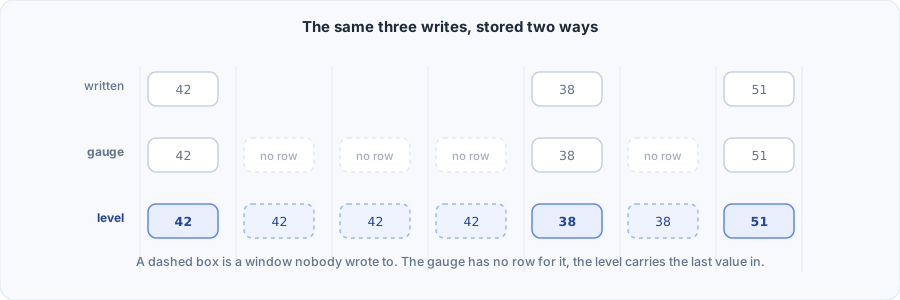
Each flush does one thing before it claims anything. It walks every series forward from the last window it carried, up to the newest closed window, and writes the held value into each window that has none.
writes        42 .  .  .  38 .  .
stored        42 42 42 42 38 38 38
              ^           ^
              set()       set()
The walk goes forwards through what was actually written, rather than stamping the current value across the whole gap. Set a queue to 42 at noon and to 38 at three, and the windows in between hold 42. The queue changed at three, so it did not change at noon.
A value somebody wrote always beats a carried one, whichever of the two lands first. Two processes carrying the same window write the same number, so they cannot disagree.
Three consequences worth knowing:
- A series appears from its first write. Nothing is backfilled before it, so a queue declared on Monday and first written on Friday has no Monday rows.
- The carry happens at flush. A level that never flushes never carries, so the windows appear when the metric ships rather than as the clock passes.
- Coming back from downtime leaves a gap. A process off for a day owes 86,400 windows per series at
resolution: '1s', and writing them all would claim the queue was measured throughout a period when nothing was watching. PastMAX_CARRY_BUCKETS, which is 10,000, the older windows are skipped and the gap stays in the data.
What it costs
A counter writes a row for a window something happened in. A level writes one for every window, for every series, forever.
| Series | Resolution | Rows per year |
|---|---|---|
| 1 | '1m' | 525,600 |
| 10 | '1m' | 5,256,000 |
| 10 | '10s' | 31,536,000 |
| 100 | '1m' | 52,560,000 |
Those numbers arrive whether or not anything moved. Two settings bring them down: a wider resolution, and holdFor on a dim whose values come and go.
Reach for a gauge when you are sampling something, and for a level when the gap between writes is the part you need filled.
The row
{
  id: '...',
  bucket_ts: Date,
  queue: 'email',
  value: 42,
}| Column | Meaning |
|---|---|
id | Derived from the name, the window and the dim values |
bucket_ts | The start of the window |
| one per dim | The label values for this series |
value | What the series was at when the window closed |
Inside write, each row is a LevelRow<D>. See Rows are typed.
Table schema
CREATE TABLE queue_depth (
  id         String,
  bucket_ts  DateTime64(3),
  queue      LowCardinality(String),
  value      Float64
)
ENGINE = ReplacingMergeTree
ORDER BY (bucket_ts, queue);CREATE TABLE queue_depth (
id TEXT PRIMARY KEY,
bucket_ts TIMESTAMPTZ NOT NULL,
queue TEXT NOT NULL,
value DOUBLE PRECISION NOT NULL
);Queries
-- The deepest each queue got per hour, and where it sat on average.
SELECT
  toStartOfHour(bucket_ts) AS hour,
  queue,
  max(value) AS deepest,
  avg(value) AS typical
FROM queue_depth
WHERE bucket_ts >= now() - INTERVAL 1 DAY
GROUP BY hour, queue
ORDER BY deepest DESC;
What a level does not do
It does not aggregate inside a window. A series written five times in one minute stores the fifth value, and the other four are gone. For the minimum and maximum inside each window, use a gauge, and writing to both is reasonable.
It does not know why it changed. A level going from 42 to 38 does not say whether four items were processed or four were cancelled. Pair it with a counter when the reason matters.
Patterns
A job queue, reported by its worker
// metrics/schema.ts
import { level, oneOf, str } from 'metrichouse/core'
import { toClickHouse } from './sinks.js'

export const queueDepth = level('queue_depth', {
  dims: {
    queue: oneOf(['email', 'export', 'webhooks']),
    instance: str(),
  },

  // One row per minute per queue per instance. Coarse enough to stay cheap,
  // fine enough to show a backlog building before anyone complains.
  resolution: '1m',
  flush: '1m',

  // An instance that stops reporting for ten minutes has gone away, and its
  // last depth should go with it rather than sit on the chart.
  holdFor: '10m',

  write: toClickHouse('queue_depth'),
})// queue/report.ts
import { queueDepth } from '../metrics/schema.js'
import { queues } from './queues.js'
const instance = process.env.HOSTNAME ?? 'local'
export function startReporting() {
// Written on change rather than on a timer: a level does not need a sample
// per window, because the windows in between are filled in for it.
for (const [name, queue] of Object.entries(queues)) {
queue.on('change', () => {
queueDepth.set(queue.size(), { queue: name, instance })
})
}
}Pausing intake on depth
The held value is readable before anything ships, so a level can drive a decision.
export async function shouldPause(queue: string) {
  const depth = await queueDepth.current({ queue, instance })

  // Nothing has reported yet, so there is no backlog to react to.
  if (depth === undefined) return false

  return depth > 10_000
}
Playground
A level buckets like a counter, so the same two settings decide the same things. What changes is that every series produces a row in every window rather than only in the windows it was written in.
Try it: resolution inside flush
The declaration these settings produce
level('queue_depth', {
  resolution: '1m',
  flush: '1m',
  write: async (rows) => db.insert(rows),
})
Your sink receives id, bucket_ts, …dims, value, one row per combination per bucket.